
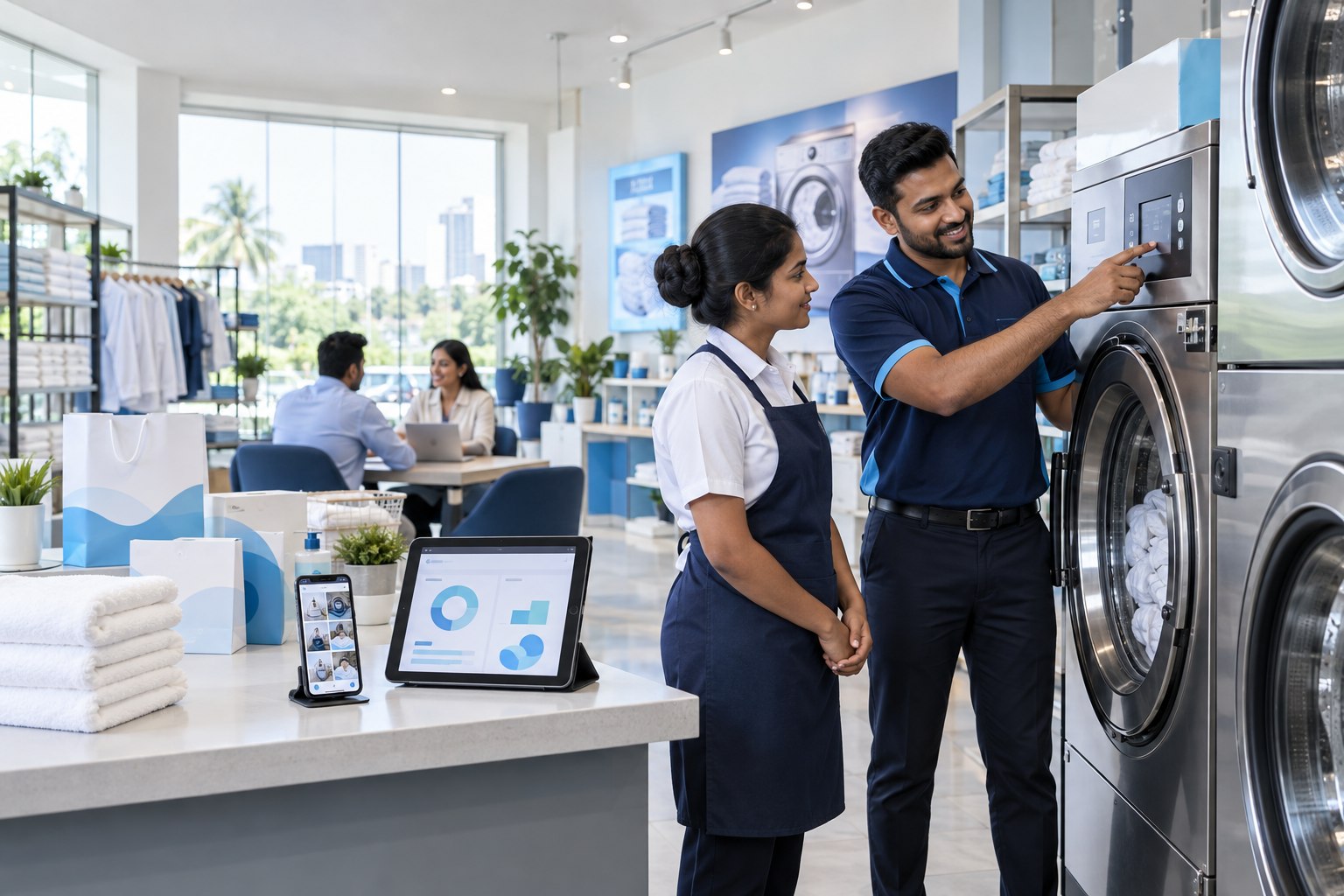
If you are thinking about starting a business in Sri Lanka, laundry deserves a closer look. Clothes, towels and linen need care again and again. A well-run laundry can turn that recurring need into lasting customer relationships, with room to grow from a focused local service into a larger operation.
The opportunity is valuable because customers pay for more than clean clothes: they pay for time saved, reliable collection, careful handling and a service they can trust. Your location, costs and consistency determine how well that opportunity works for you.
1. An everyday need can bring repeat customers
Unlike a one-time purchase, laundry is a repeating task. Households, working professionals and accommodation providers may need help on a regular schedule. When your team delivers clean, correctly finished items on time, customers have a reason to return.
Start by learning who needs the service in your area. Talk to potential customers about their current arrangements, what goes wrong, how often they need help and what they would pay for reliable service.
2. You can serve more than one customer group
A laundry can serve individual customers and business clients such as guesthouses, salons, gyms and restaurants. Each group has different requirements: a household may value convenience, while a guesthouse may need consistent linen turnaround.
Choose an initial customer group that matches your capacity. Large contracts can create regular work, but also require dependable output, transport, payment terms and enough working capital. Specialised or clinical textiles require appropriate processes and expertise; do not assume every item can use the same workflow.
3. Convenience gives customers a reason to choose you
Clear pricing, convenient opening hours, accurate order records and helpful communication can make a small laundry stand out. Collection and delivery may add value where route density makes the transport cost worthwhile.
Make the experience simple: record each order, explain when it will be ready, notify the customer and handle questions promptly. Reliability is something a customer can experience on every visit.
4. Industrial equipment supports a professional operation
Your equipment should suit the workload, fabrics, available space and utilities. Plan washing, drying and finishing together so one stage does not hold up the others. Industrial washers, industrial dryers, industrial irons and industrial iron tables each have a role in the workflow.
Laundryinfo.lk supplies industrial laundry equipment for business use; we do not supply home-use equipment. Before choosing machines, discuss capacity, installation requirements, maintenance and after-sales support with our team.
Running costs matter as much as the purchase price. Compare water and energy use for the models you are considering. U.S. Department of Energy guidance identifies laundry as a water-intensive process and discusses efficiency measures. Savings at your site depend on your machines, usage and local utility costs.
5. Systems make growth easier to manage
As orders increase, handwritten notes can become harder to track. A laundry management system can help you organise orders, customer details, payments, stock and reports. It also gives your team a clearer view of what is pending and what is ready.
Software works best alongside trained staff and a consistent process. Start with a workflow your team understands, then use your records to spot delays, repeat issues and services customers request most often.
6. Build value through service, training and a recognisable brand
The future value of your laundry comes from the business you build around the machines: returning customers, capable staff, reliable processes and a name people recommend. Practical training helps your team handle fabrics, stains, washing, drying and finishing consistently.
A clear shopfront, useful online information and honest customer feedback help new customers understand your service. Grow at a pace your quality and cash flow can support.
Check the numbers before you commit
A laundry is not automatically profitable. Estimate rent, wages, utilities, chemicals, packaging, maintenance, transport, finance costs and the money needed while sales build. Keep a reserve for repairs and quieter periods.
A useful planning calculation is: monthly fixed costs ÷ contribution per order = orders needed to cover fixed costs. Contribution per order means your selling price minus the costs that change with each order. Use realistic local quotes and allow for your service mix; this is a starting estimate, not a profit forecast.
Your first steps
- Identify your local customers and speak to them about their needs.
- Choose a suitable location and check water, drainage, power and space.
- Plan industrial equipment capacity around realistic demand.
- Set prices, estimate costs and prepare working capital.
- Train your team, set up order tracking and launch with a clear service promise.
Start with a practical plan
A laundry business can be a worthwhile long-term opportunity for an owner who understands local demand and takes service seriously. You do not need to solve everything alone. Laundryinfo.lk connects startup guidance, industrial equipment, hands-on training, management software and marketing support across Sri Lanka.
Initial consultation and startup guidance are free. Site visits and equipment, training, software and marketing services are charged separately.